Planning for tomorrow should not make today’s student invisible.
High-school students are managing academics, friendships, family expectations, extracurriculars, work, college decisions and uncertainty about what comes next. Their daily voice still matters. LAUNCH ME™ carries the same daily check-in, reflection and Care Check™ support pathway through all four years of high school so future planning stays connected to the student’s current experience.
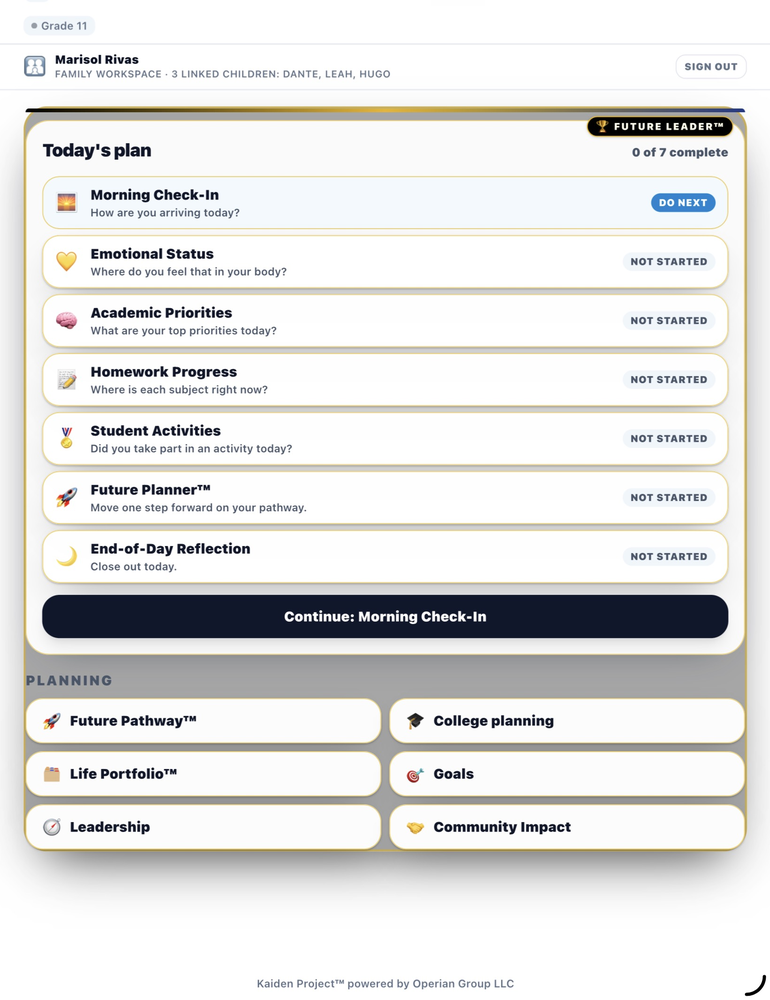
One clear path through the school day. Morning Check-In establishes how the student is arriving. Emotional Status. Academic Priorities. Homework Progress. Student Activities. Future Planner™. End-of-Day Reflection. Each completed step creates structured growth evidence from the student’s own interaction.
Big futures are built through small commitments.
Purpose Builder™ turns long-term ambition into manageable weekly action. Students select three commitments per week from structured options covering college or trade school preparation, real-world experience, professional skills, leadership, reliability and accountability. These are not rankings against classmates. They are student-selected commitments designed to create habits, evidence and direction over time.
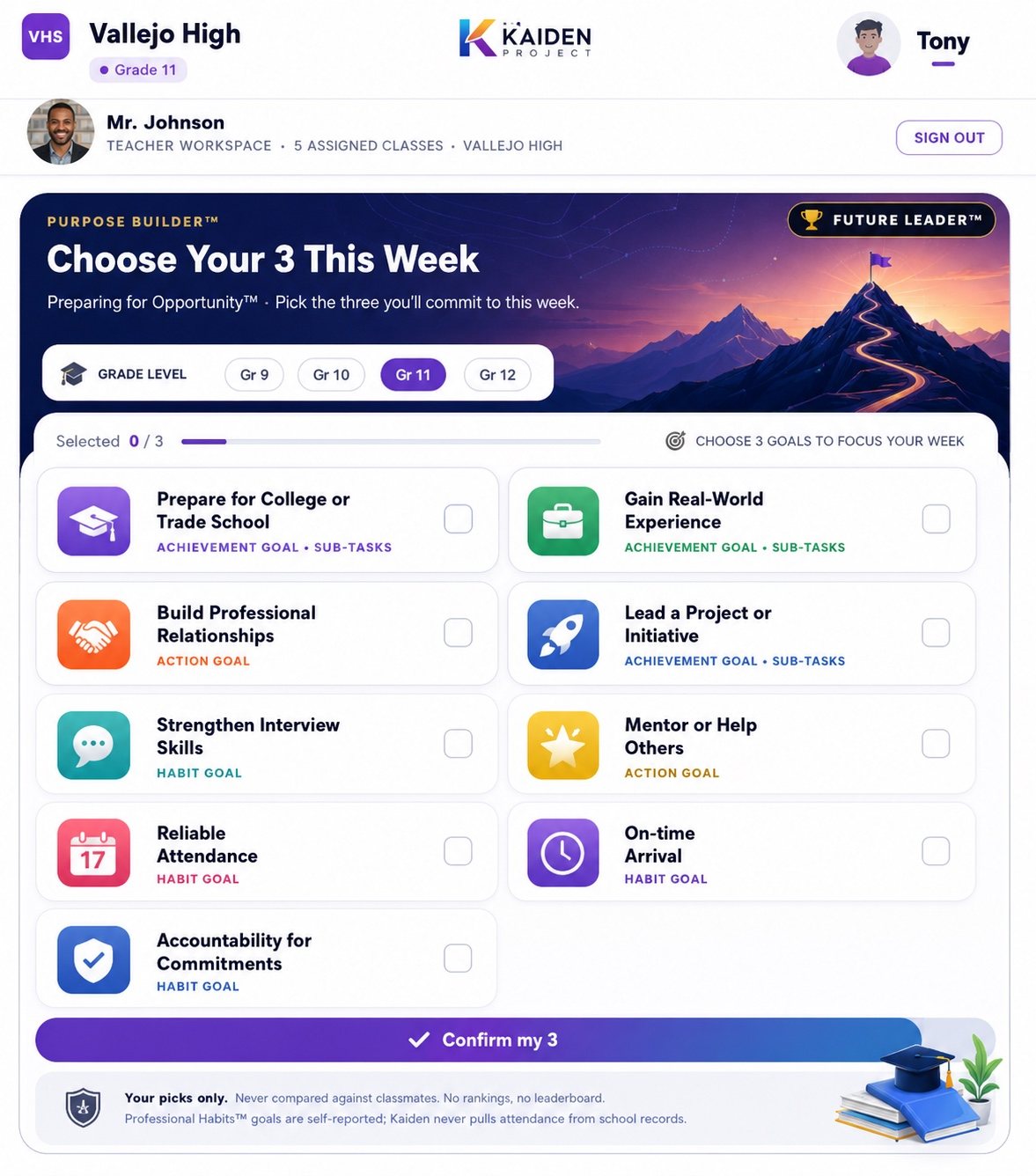
Choose Your 3 This Week. Your picks only. Never compared against classmates. No rankings, no leaderboard. Purpose Builder™ connects daily goal choices to a student’s Life Portfolio™ over time. Future planning becomes part of the school week — not something postponed until senior year.
Students begin with possibilities — not a predetermined destination.
A student does not need to arrive in ninth grade already knowing a job title. LAUNCH ME™ gives students an organized way to explore industries, compare pathways and discover options they may never have considered. College is one path. Trades, certifications, apprenticeships and workforce pathways are also real paths. All receive equal legitimacy.
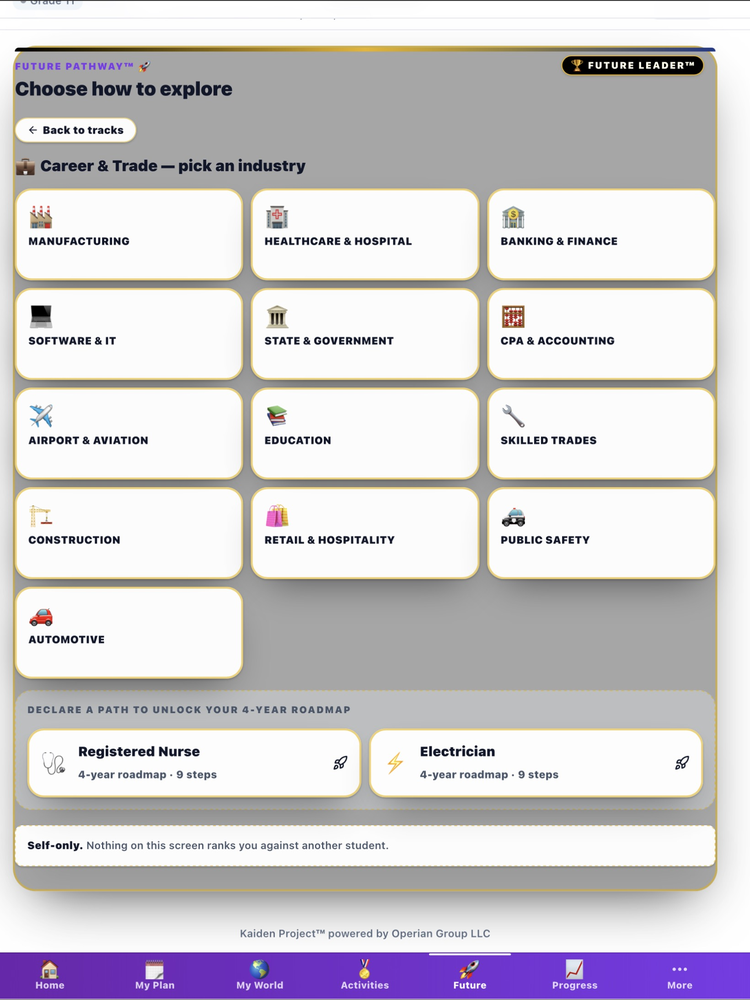
LAUNCH ME™ shows the breadth first. A student selects an industry they want to explore — the system then surfaces career options, education routes, high-school class preparation and, where configured, local opportunities. Interest becomes a starting point, not a locked-in prediction.
Exploration should answer practical questions — not just show job titles.
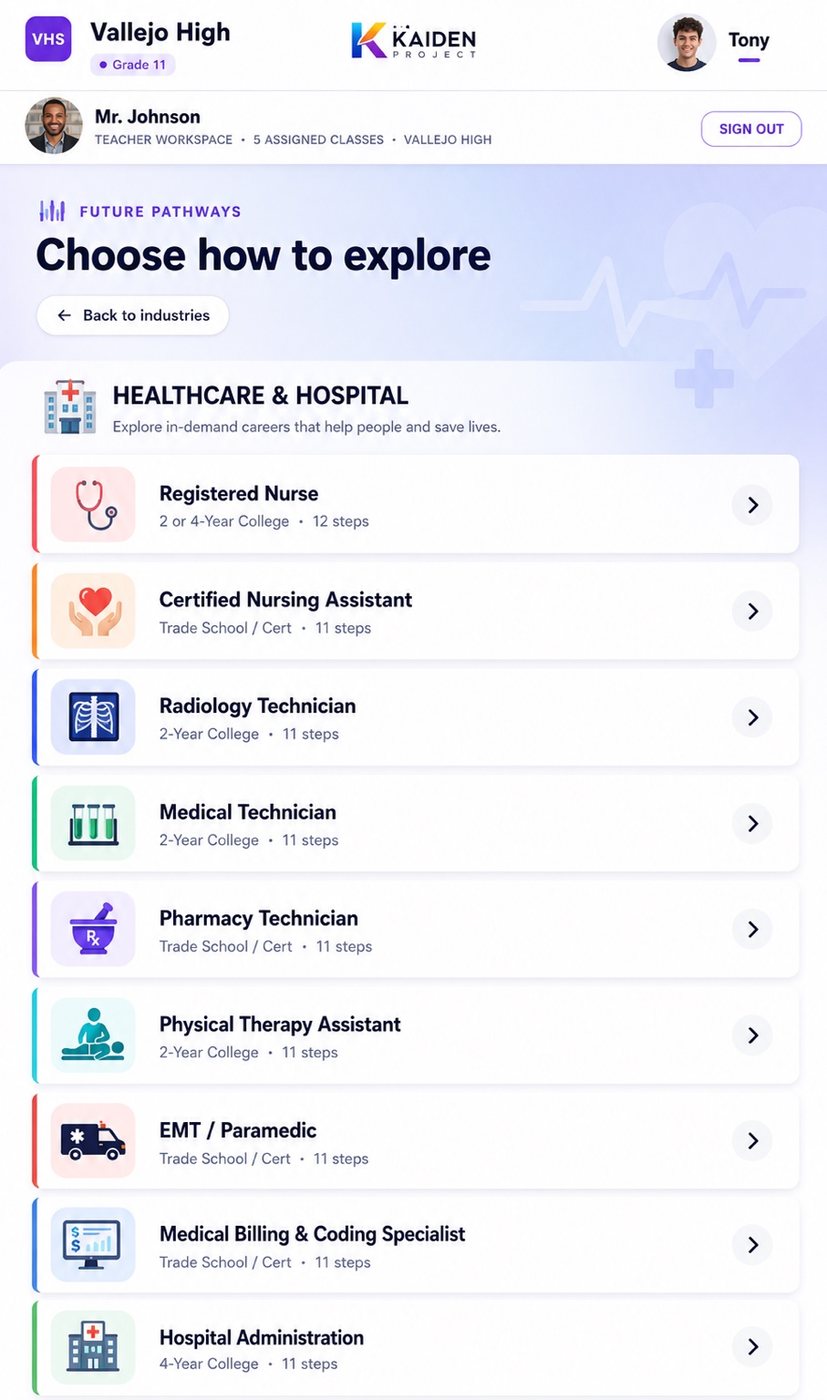
Healthcare and Hospital — one of many configured pathways. A student who selects Healthcare sees in-demand career options with detail on education routes, required steps, and typical responsibilities. Counselor notification is built in when a pathway is declared. This is one pathway, not the entire feature.
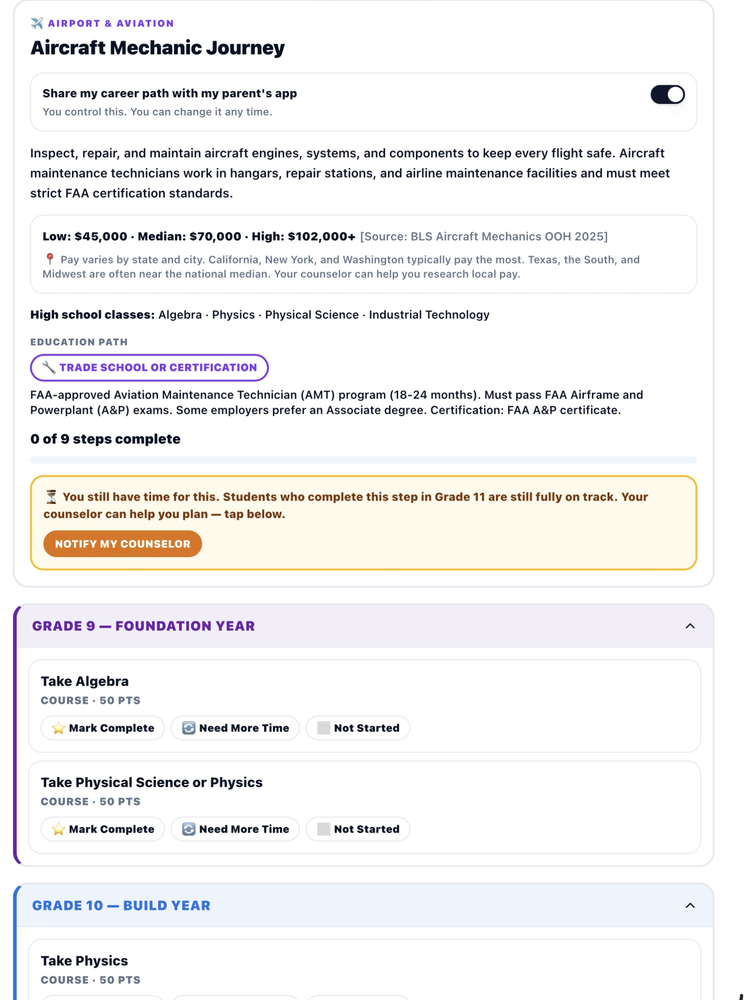
A career becomes easier to understand when students can see what the work involves, which high-school classes are useful, what education or certification is required, where local opportunities may exist, and what the next action could be. Labor market information comes from public sources and is labeled accordingly.
A career interest becomes a grade-by-grade roadmap.
LAUNCH ME™ turns "I might want to become an electrician" into a four-year sequence a student can actually follow. The roadmap connects today’s class schedule to real next steps across all four years of high school — and brings the counselor back in at key milestone checkpoints before the student moves to the next stage.
Grade 9 — Foundation Year
Build foundational coursework. Begin understanding the path. Explore initial career and trade options.
Grade 10 — Build Year
Explore CTE and vocational opportunities. Investigate training requirements. Begin building skills.
Grade 11 — Application Year
Gain real-world exposure, job shadow, research apprenticeships. Meet with a counselor before proceeding.
Grade 12 — Capstone Year
Apply. Reflect. Complete the post-graduation plan. Transition toward the next stage with required counselor checkpoint.
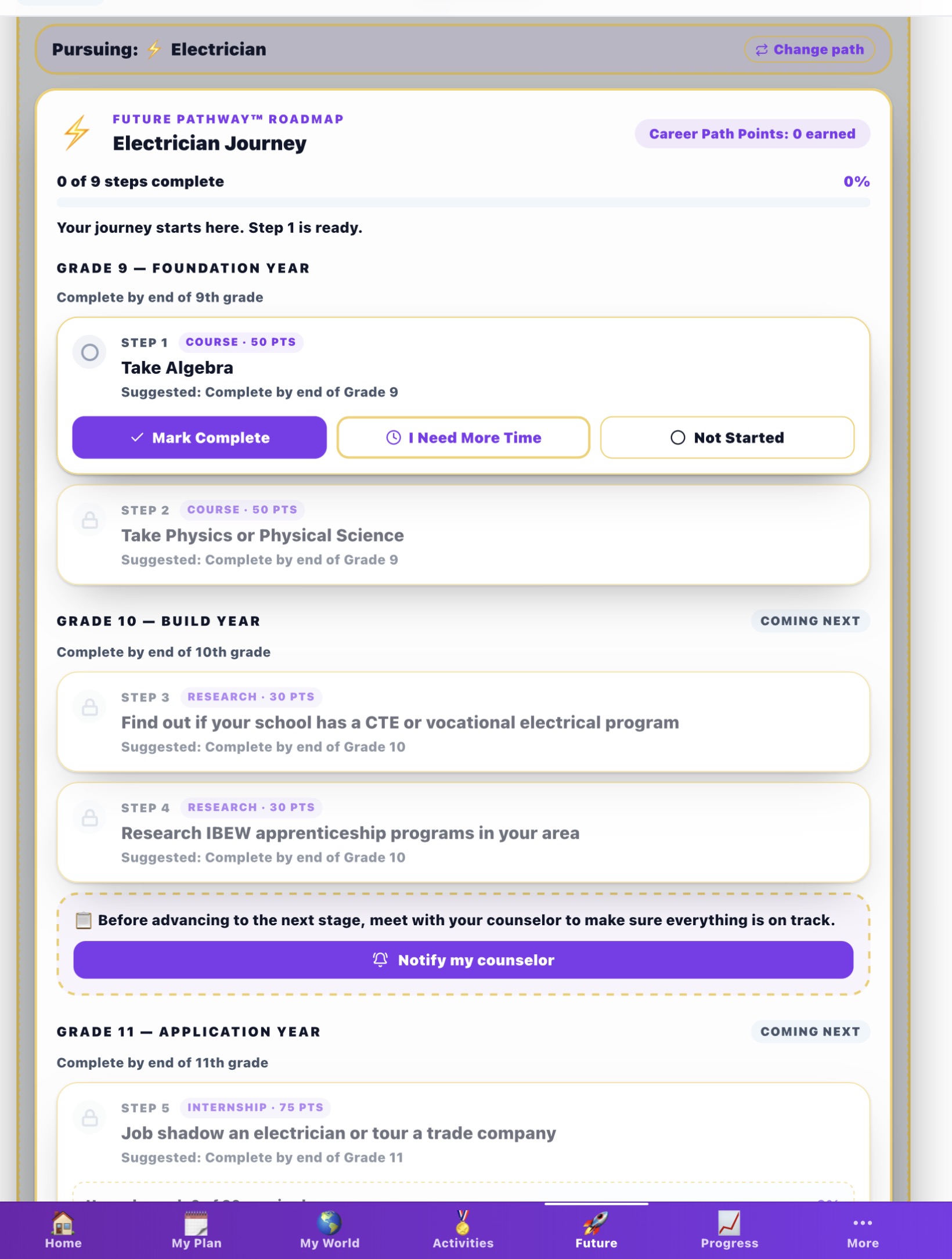
Grade 9 and 10 steps in the Electrician pathway. Each step is specific, actionable and tied to real requirements. Notify My Counselor checkpoint is built in before Grade 11 begins.
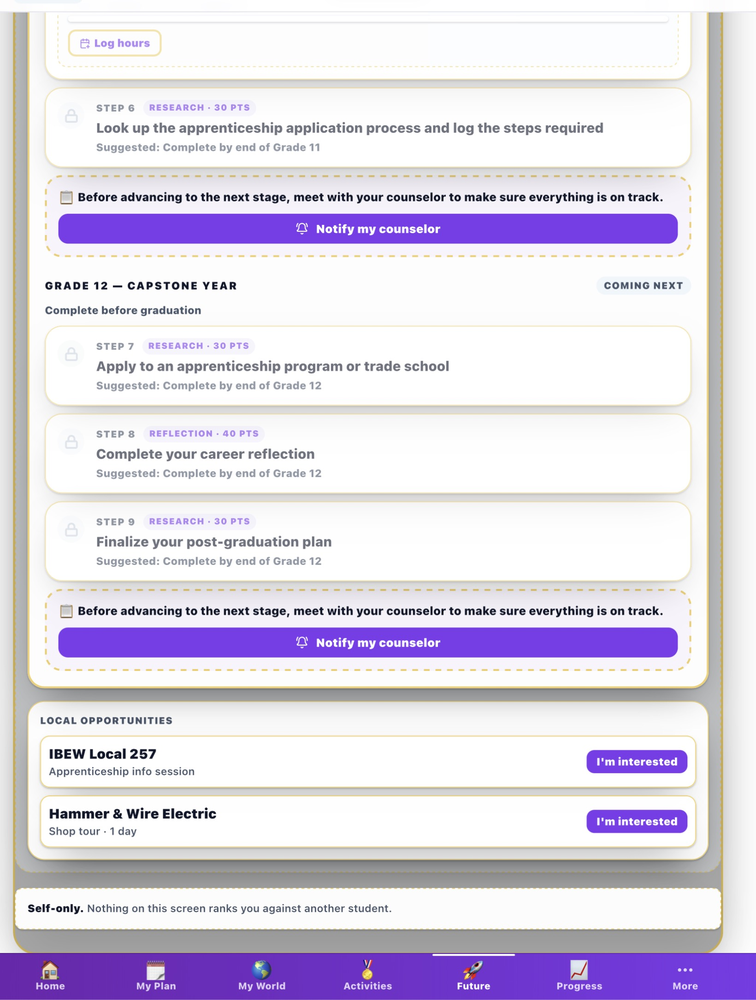
Grade 11 and 12 stages. Application-year activities include job shadowing and apprenticeship research. Capstone year connects to the post-graduation transition. Second counselor checkpoint is required before the student completes the roadmap.
The roadmap does not leave the student to navigate alone. At appropriate checkpoints, the platform directs the student back toward counselor guidance before the next stage. Technology organizes the journey. Counselors guide the student.
Before choosing a major, help students understand what interests them.
College Track™ begins with identity, not with a list of majors. Students first identify how they engage with the world — as a Builder, Protector, Investigator, Creator, Leader, Helper, Innovator or Competitor. These are exploration starting points, not labels, scores or predictions about what a student will become.
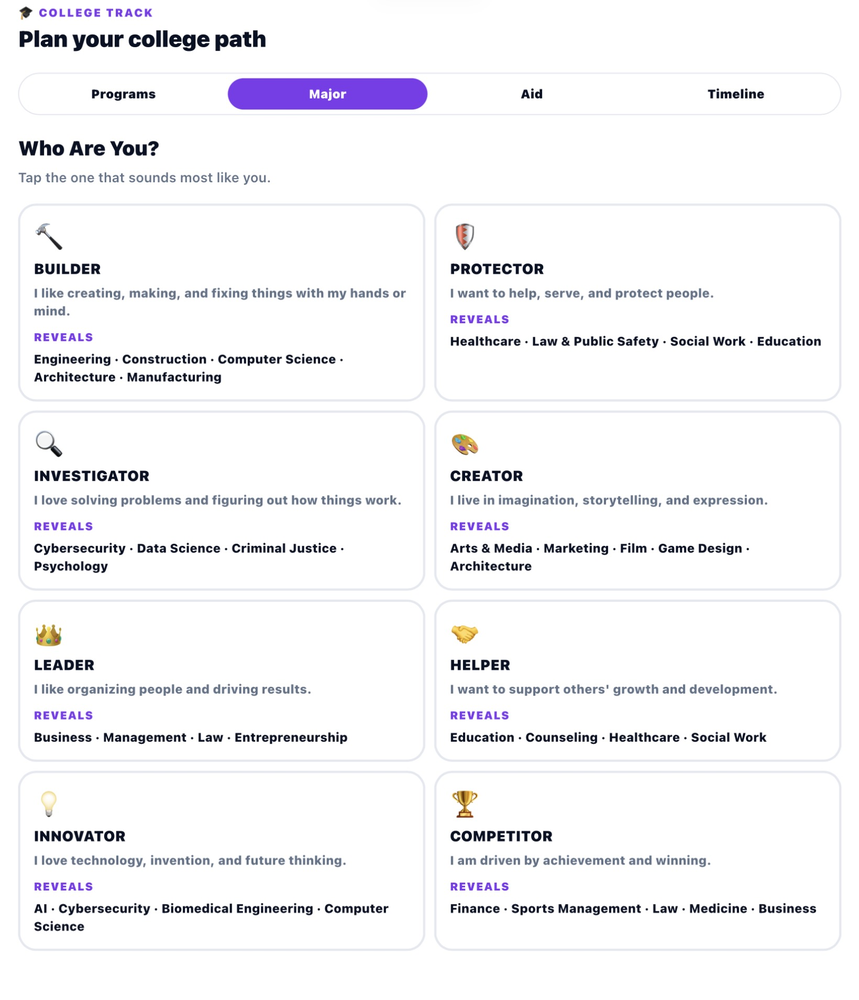
WHO ARE YOU? Eight starting points that map loosely to how a student engages with ideas, people, challenges and the world. Selecting one is not permanent. It opens a set of relevant major categories to explore. Identity exploration starting point — not a personality assessment, not a label, not a predictive score.
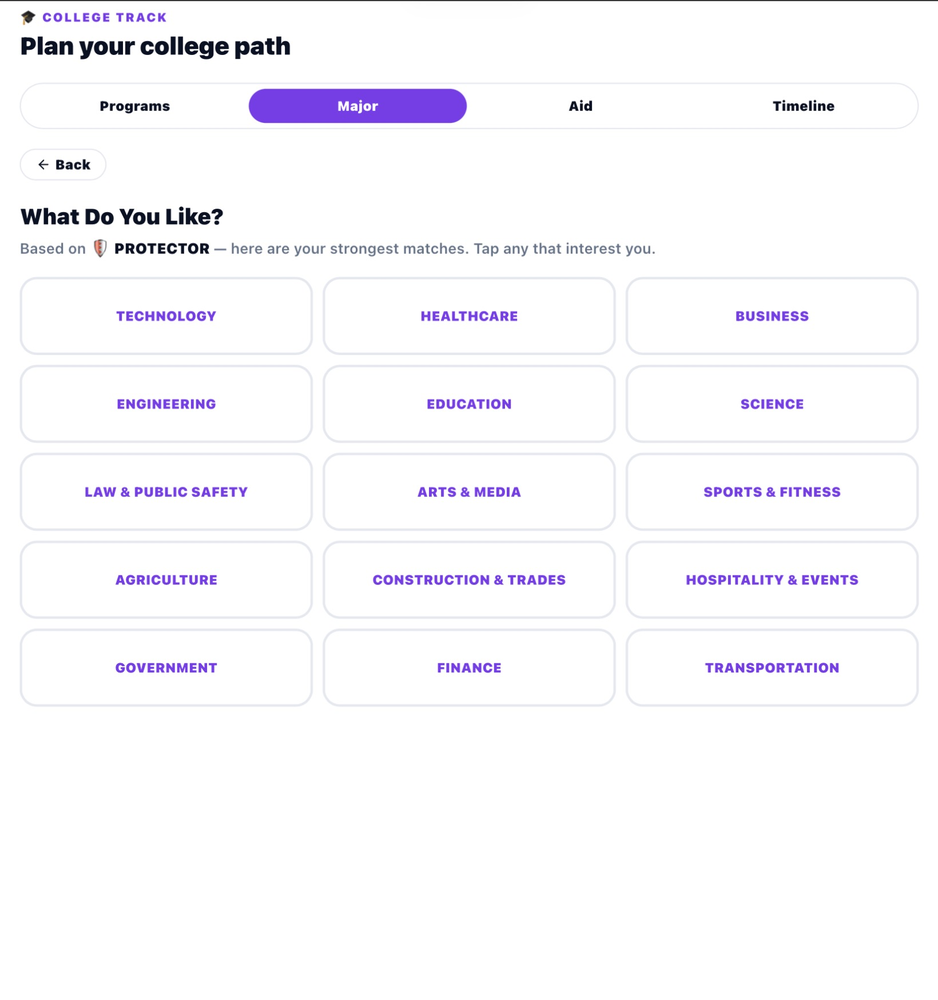
Based on the student's selected starting point, LAUNCH ME™ surfaces major categories that may resonate. Technology. Engineering. Healthcare. Education. Business. Public Service. The student explores, not the algorithm. Every choice remains student-directed.
“I like technology” can become “I want to understand Computer Science.”
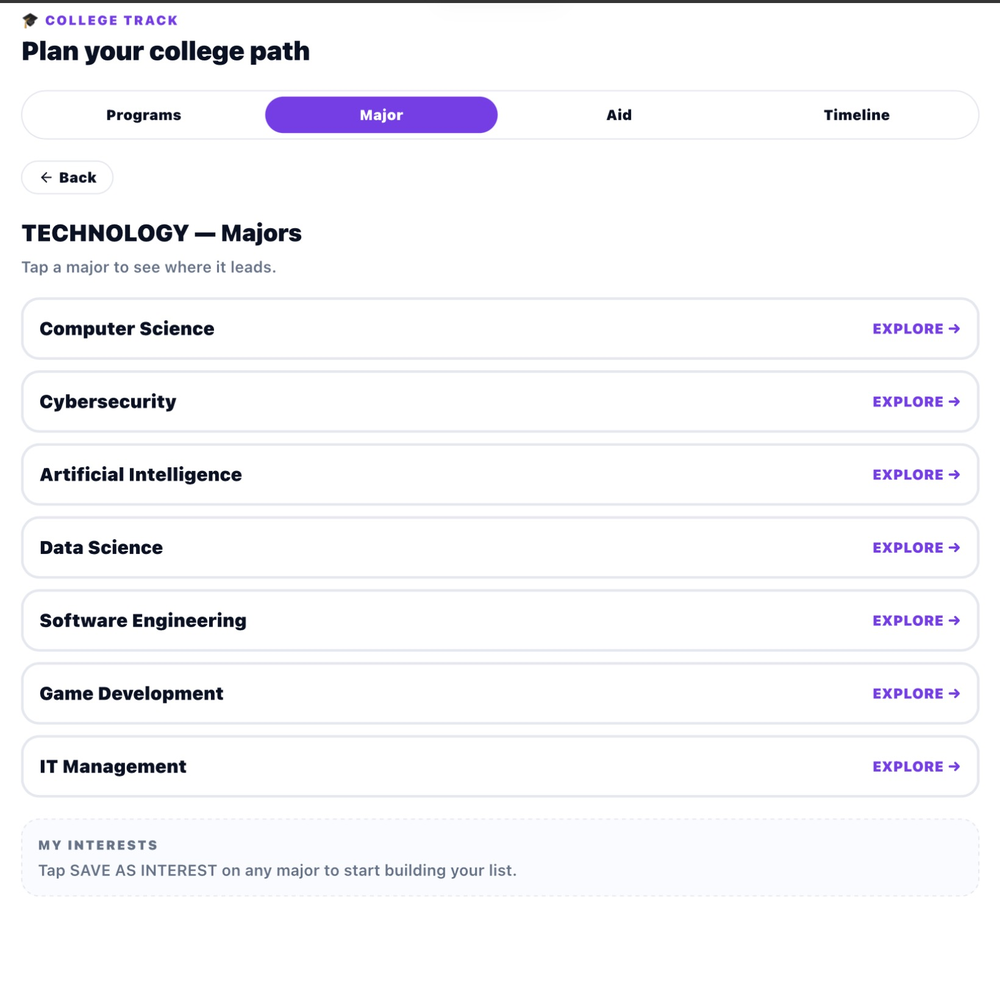
Six distinct majors within Technology. A student who says they like computers can now distinguish between writing code, securing systems, training AI models, analyzing data, building software products and designing games. Specificity creates more meaningful exploration.
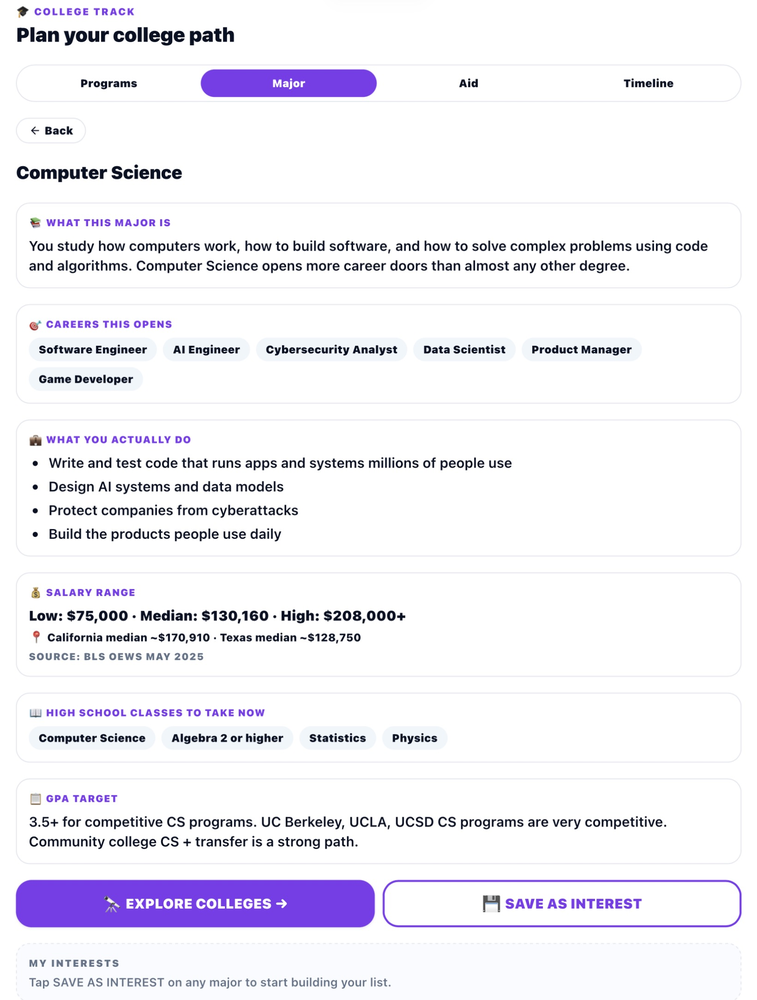
A major becomes easier to understand when a student can see what careers it opens, what people in the field actually do, which high-school classes are useful, what GPA range is worth targeting, and what labor-market data suggests. Salary figures come from BLS 2025 and are labeled as public context, not a guarantee.
There is more than one legitimate route forward.
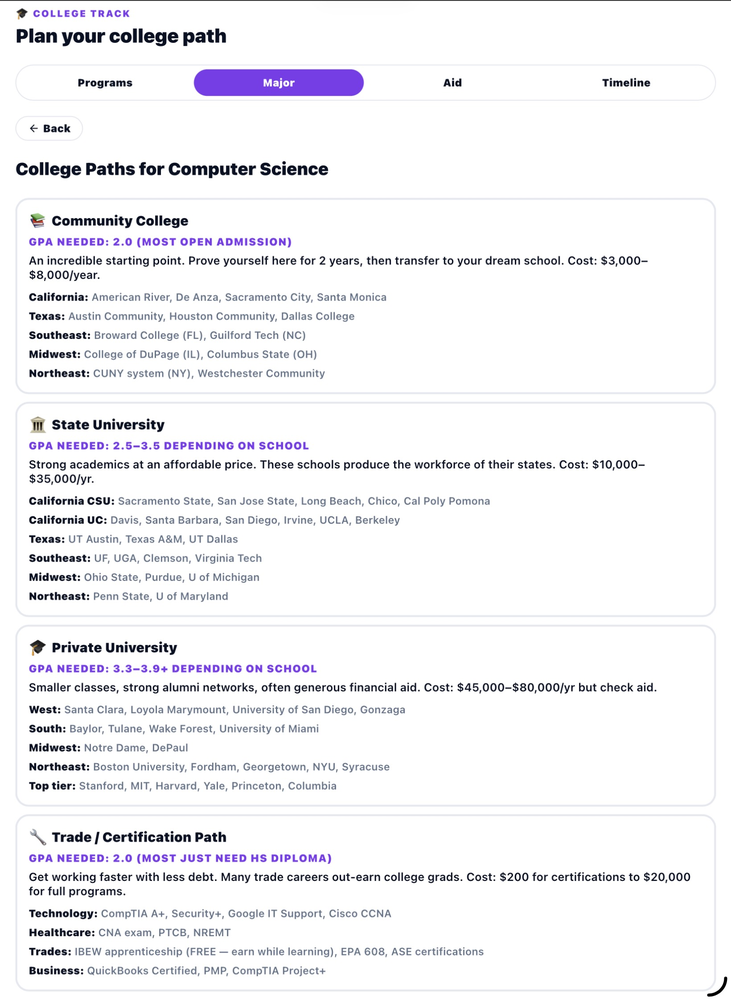
The Kaiden Project does not define success as one destination. A student can understand community college, state university, private university and trade or certification as four different legitimate routes to a career in the same field. Each has its own timeline, cost considerations and next steps. The student chooses. Kaiden informs.
Technology can organize the journey. Counselors still guide the student.
A career roadmap does not replace the counselor. LAUNCH ME™ helps students organize interests, requirements, milestones and questions so counselor conversations begin with more context. At important milestone gates, the student is directed to reconnect with an appropriate counselor before moving forward.
Explores industry → selects pathway → roadmap appears → milestone approaches
Notify My Counselor — student is prompted to meet with their counselor before the next stage
Reviews pathway context with the student. Conversation begins informed, not from scratch
Continues with counselor guidance toward the next milestone
Where configured, students can share appropriate future-path context with their family so parents and guardians can understand where the student is headed and support the journey at home.
Graduation should reveal the journey — not erase it.
Across high school, students can accumulate a record of goals, milestones, interests explored, activities, leadership, recognitions, real-world experiences, career exploration, pathway progress and reflections. These appropriate interactions can contribute to the student’s continuing Growth Record™ and Life Portfolio™ over time.
Not just what classes they took. What they built along the way.
One student. Four years. One continuing record.
Daily Growth → Weekly Commitments → Pathway → Experience → Counselor Guidance → Life Portfolio™
What would it change if every student entered graduation already understanding the pathway they were building toward?