What matures from BUILD ME™ to FIND ME™
BUILD ME™ · K–5
“Who do I want to be today?”
Recognize. Express. Try. Ask for help. Build daily habits with guidance.
FIND ME™ · 6–8
“What am I responsible for, and who am I becoming?”
Choose. Own. Practice. Reflect. Build identity and academic responsibility autonomously.
The Growth Record™ that began in elementary school continues. The interface, the questions, and the ownership model mature alongside the student. Middle school is not a reset — it is the next chapter of the same record.
Check in. Then see the bigger picture.
After completing their check-in, students return to My Kaiden Workspace™ — their personal home for today’s priorities, goals, growth activity and next actions. Instead of hunting across disconnected tools, the student has one place to understand: Where am I today? What do I need to finish? What did I say I would work on? What comes next?
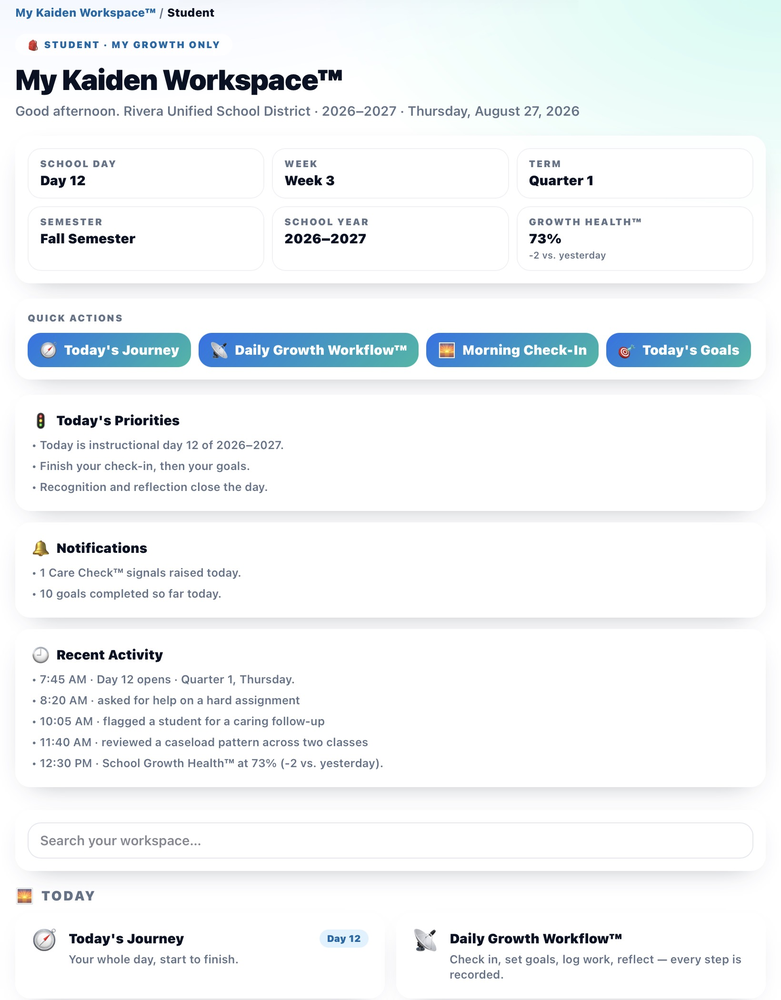
My Kaiden Workspace™ — Growth Health™ 73% (+4 vs. yesterday). Today’s Journey — Daily Growth Workflow. Recent Activity: Day opened. Morning Check-In completed. Academic priorities selected. Help requested on a hard assignment. Homework Progress updated. Daily Goal selected. All student-specific — no other students’ information is ever visible here.
Growth Health™ is not a grade. It summarizes recorded growth evidence over time. Students see direction and consistency — not a ranking against classmates. The interface shows a band first; exact values are secondary detail.
Students don’t have to guess what comes next.
Middle school brings more classes, more responsibility, more relationships and more decisions. FIND ME™ gives students one clear daily pathway that helps them organize what matters, understand how they are arriving, identify academic priorities, build goals and reflect before the day disappears.
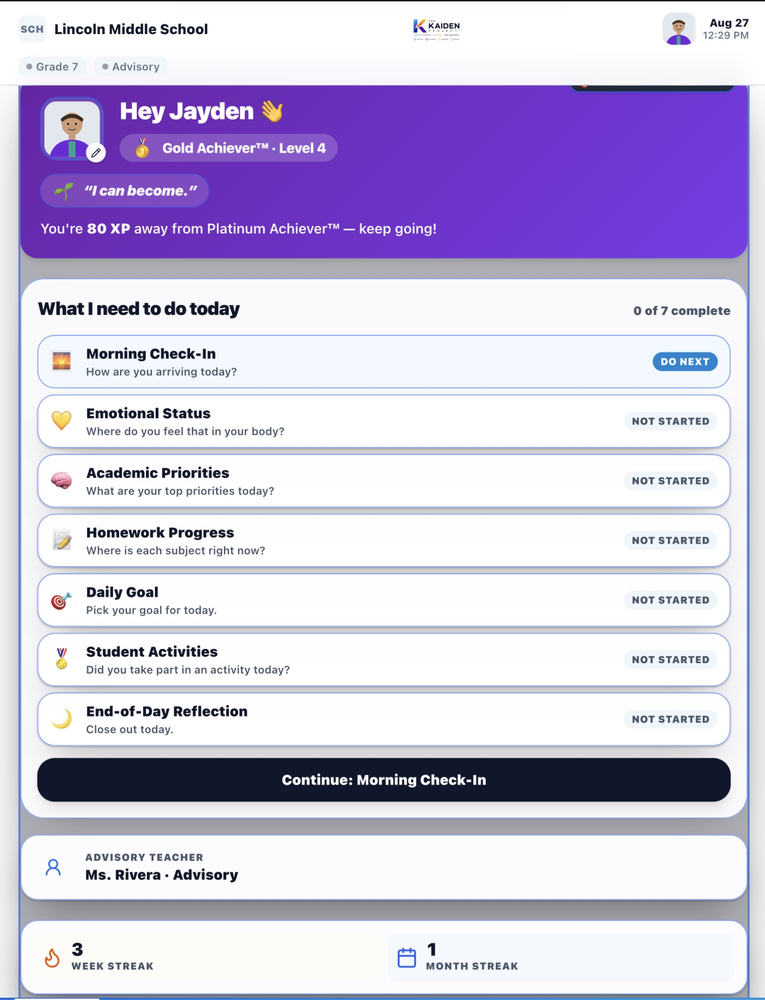
One clear path through the school day. Morning Check-In establishes how the student is arriving. Emotional Status builds age-appropriate self-awareness. Academic Priorities and Homework Progress support academic ownership. Daily Goal and Student Activities connect to identity and participation. End-of-Day Reflection closes the loop. Each completed step creates evidence in the Growth Record™.
Students learn to see where they stand before adults have to chase them.
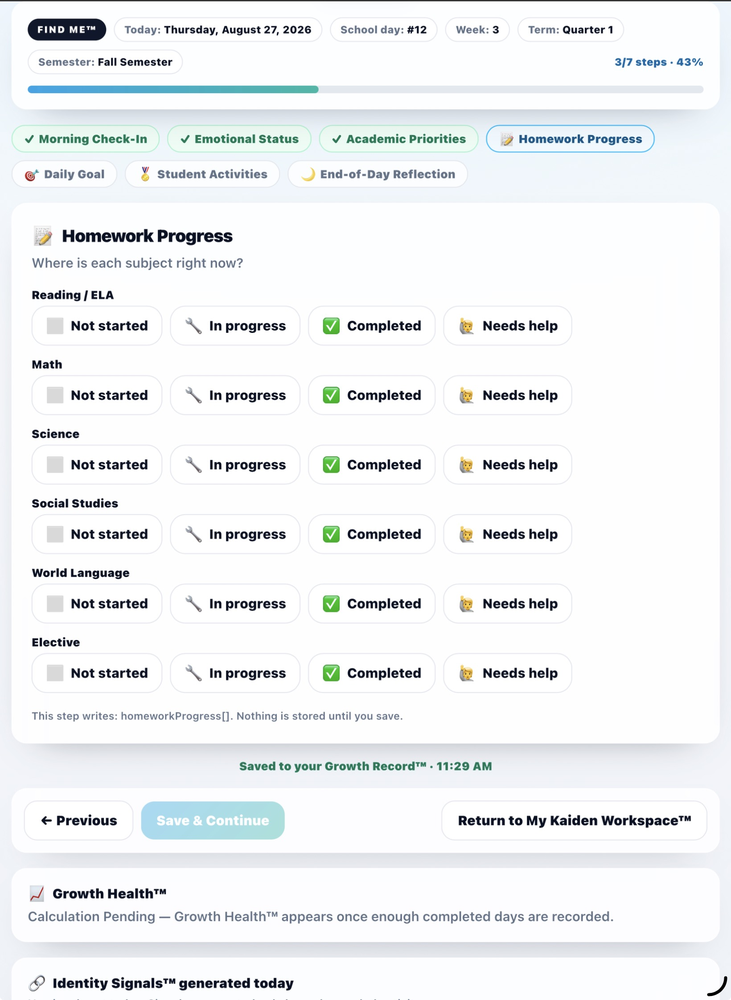
Students self-report where each subject stands: Not Started, In Progress, Completed, or Needs Help. Kaiden does not pull grades from the LMS — it captures the student’s perspective and creates a simple daily habit of academic awareness.
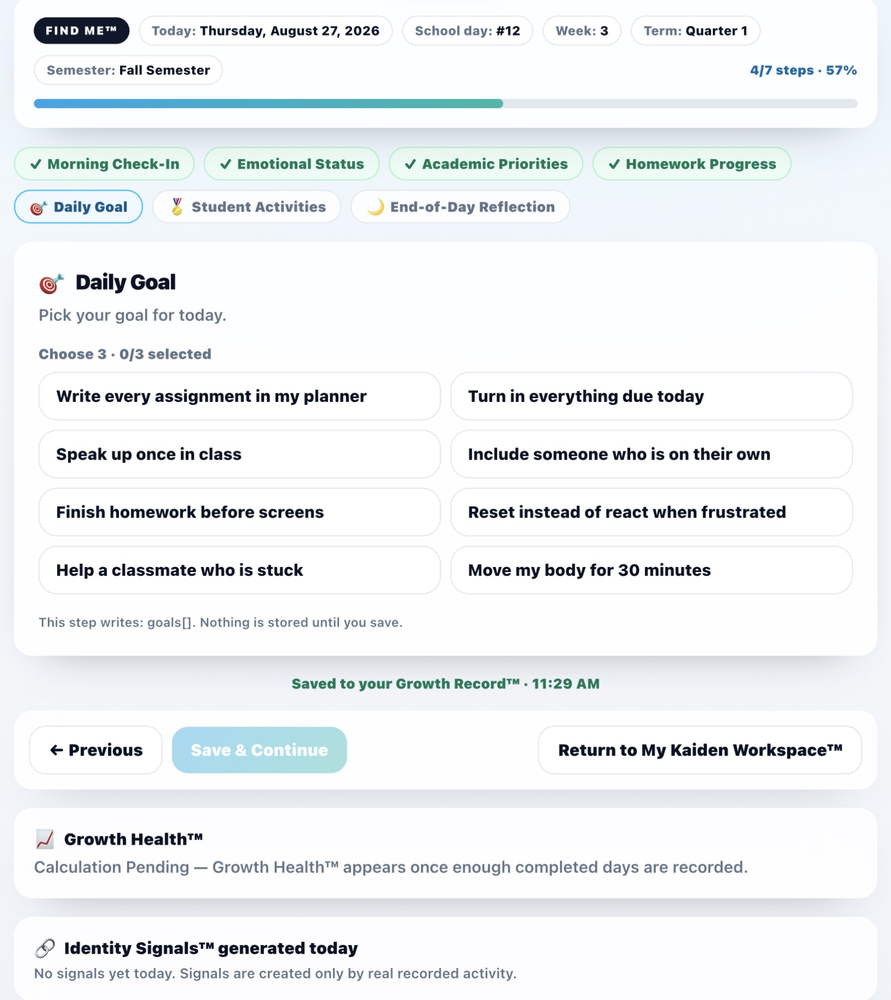
Students choose one practical action they can own today. Goals span academic ownership, belonging, self-regulation, leadership and wellness. Small daily decisions become evidence of habits, responsibility and identity over time.
Students move from daily choices to broader weekly ownership.
In elementary school, students choose a single daily intention with guidance. In FIND ME™, students choose three habits or behaviors they want to strengthen for the entire week. This expands the time horizon, increases the ownership, and builds the self-discipline that becomes increasingly important through high school and beyond.
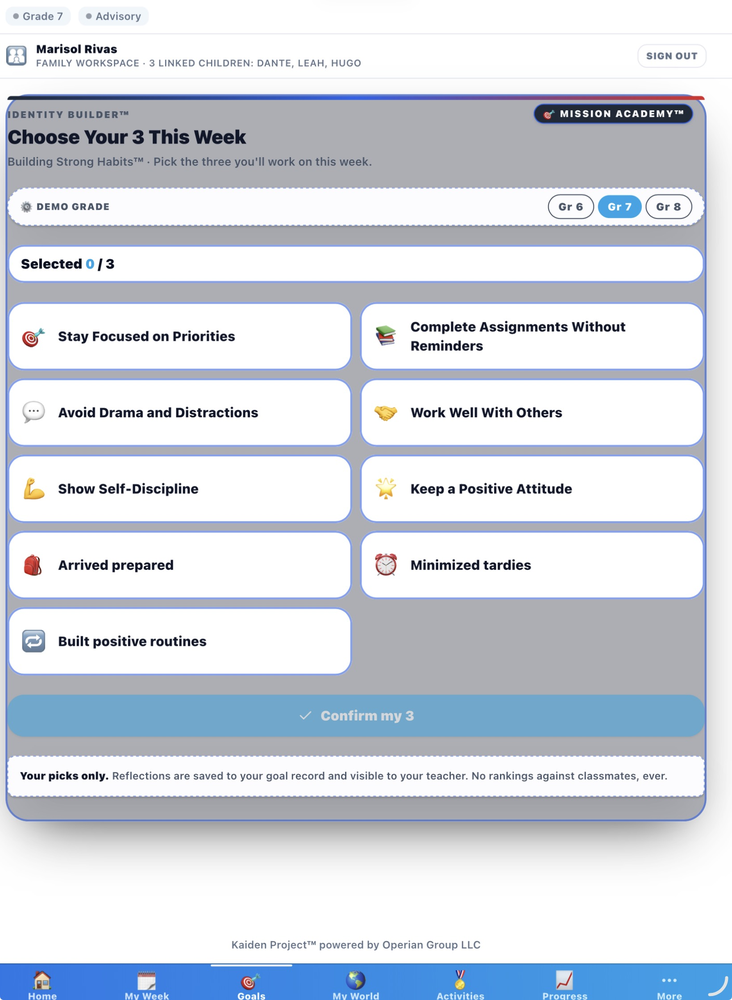
Your picks only. No rankings against classmates, ever. Students choose three habits they want to strengthen this week from structured options covering focus, assignments, self-discipline, preparation, routines and relationships. The three picks return to the student each day as a reminder of what they committed to.
Presence™
Showing up ready
Responsibility™
Owning your work
Focus™
Staying on task
Leadership™
Helping and leading
Integrity™
Doing right always
The Five Pillars provide the framework behind each weekly choice. They are not labels or scores — they are areas where students can build goals and recognize their own development.
Your progress. Not someone else’s score.
FIND ME™ helps students recognize their own patterns across academics, habits, responsibility, leadership and participation. Progress is measured against the student’s own previous evidence — never through public rankings or comparisons against classmates. A teacher note, a recognition, or a weeks-long improvement streak becomes part of the student’s own growth story.
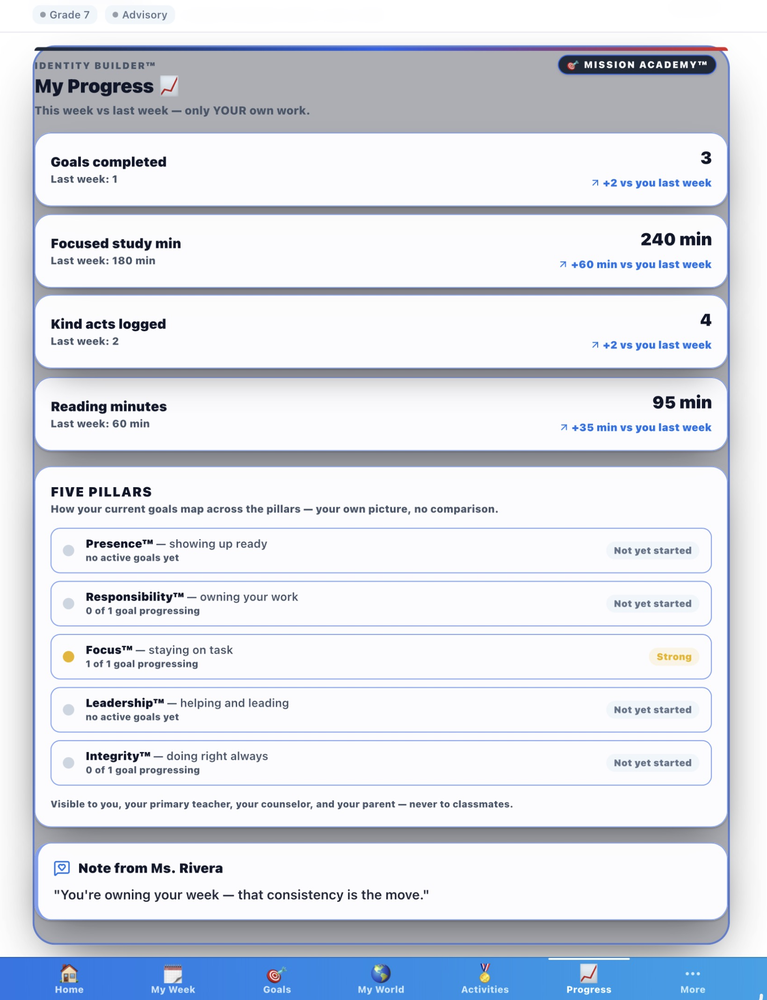
This week vs. last week — only YOUR own work. Goals completed. Focused study minutes. Kind acts logged. Reading minutes. Week-over-week improvement visible across all Five Pillars. Teacher note visible — a person, not a system, provided the encouragement. The system creates visibility. The adult provides support.
Growth Health™ is not a grade. It is not a mental-health score. It is not a ranking. It reflects the direction and consistency of the student’s own recorded activity over time. Students see whether they are moving forward compared to themselves — not compared to anyone else.
Reflection turns a school day into growth evidence.
At the end of the day, students identify the goal they worked on, what helped them, and what they want to try tomorrow. When saved, that reflection becomes part of the student’s Growth Record™. Authorized adults can see change across time — not a judgment of one isolated day.
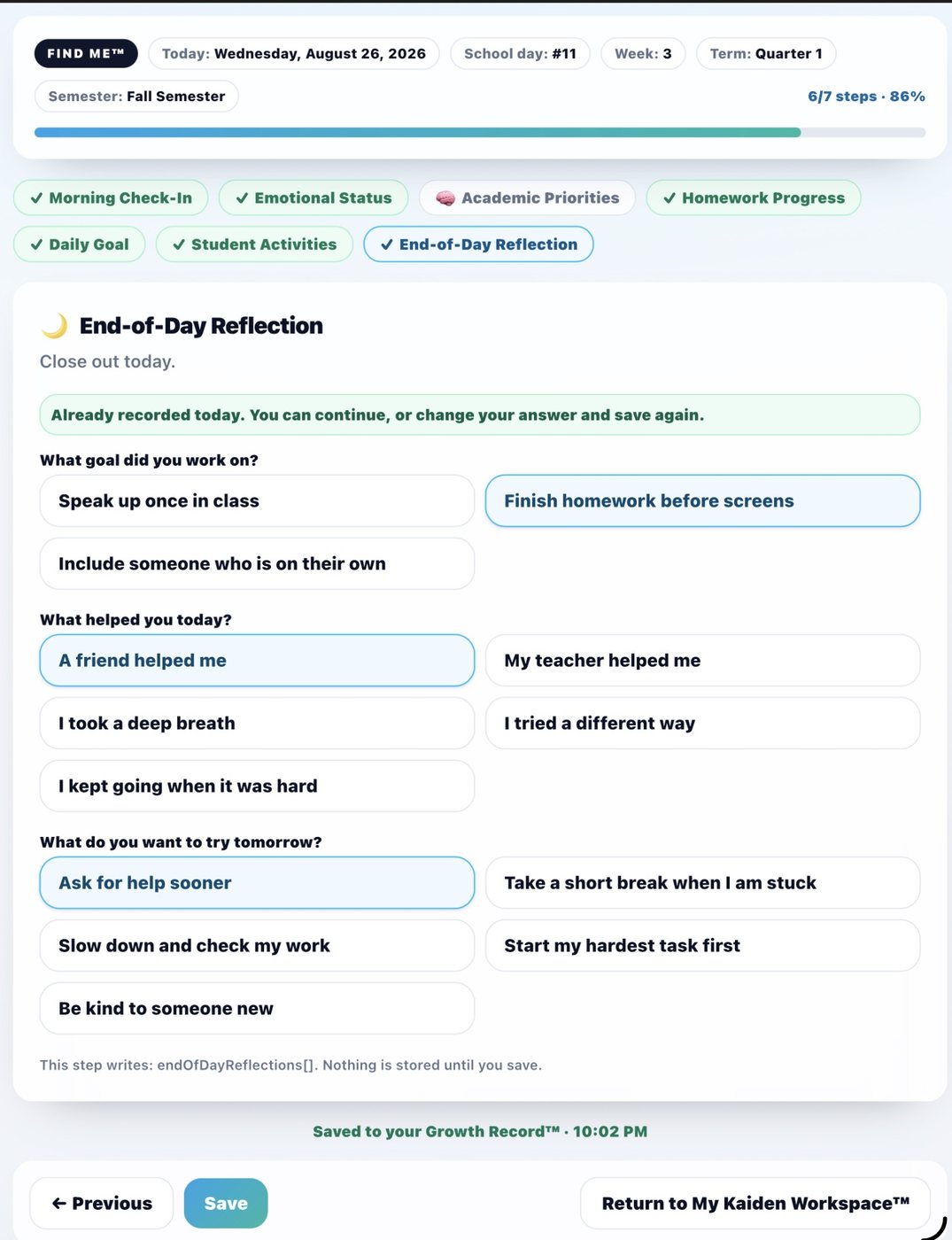
6 of 7 steps complete · 86%. End-of-Day Reflection: Which goal did you work on? (Finish homework before screens ✓). What helped you today? (A friend helped me ✓). What do you want to try tomorrow? (Ask for help sooner ✓). Saved to your Growth Record™ — 10:02 PM.
A School Day Ends. Growth Shouldn’t Disappear With It.
Each completed step — a check-in, a goal selected, a homework status reported, a reflection saved — becomes a piece of structured evidence from the student’s own interaction. Together, over days and weeks, they tell a more complete story than any single moment could.
From first bell to reflection — in Jayden’s words.
7:45 AM — My Kaiden Workspace™
Jayden opens his workspace. He sees the 7 steps for his day.
7:48 AM — Morning Check-In
Jayden reports he feels tired.
7:50 AM — Emotional Status
He identifies where he is feeling it.
7:53 AM — Academic Priorities
Math homework and his science project need attention.
10:30 AM — Homework Progress
Science is in progress. Math needs help.
10:31 AM — Care Check™
Jayden asks for help with math. Request enters the counselor-configured workflow.
12:15 PM — Daily Goal
He chooses: Ask for help sooner.
3:05 PM — Reflection
What helped: "My teacher helped me." Tomorrow: "Start my hardest task first."
None of those moments alone defines Jayden.
Together, over time, they create a clearer picture of his growth. That is the Growth Record™.
Students don’t always say it out loud.
FIND ME™ gives students a structured way to ask for support without requiring them to explain everything publicly or wait until a problem becomes visible through behavior, attendance or academic decline. The Care Check™ request enters the school-configured adult workflow — counselor first, unless the mandated-reporter obligation requires otherwise.
Patterns inform. Authorized adults decide.
AI does not diagnose students. It does not predict clinical outcomes. It does not replace counselor judgment. It organizes recorded student signals so authorized adults have a better opportunity to recognize when additional support may be needed — earlier than the lagging indicators typically reveal.
Every support need has an owner, a next step and a record.
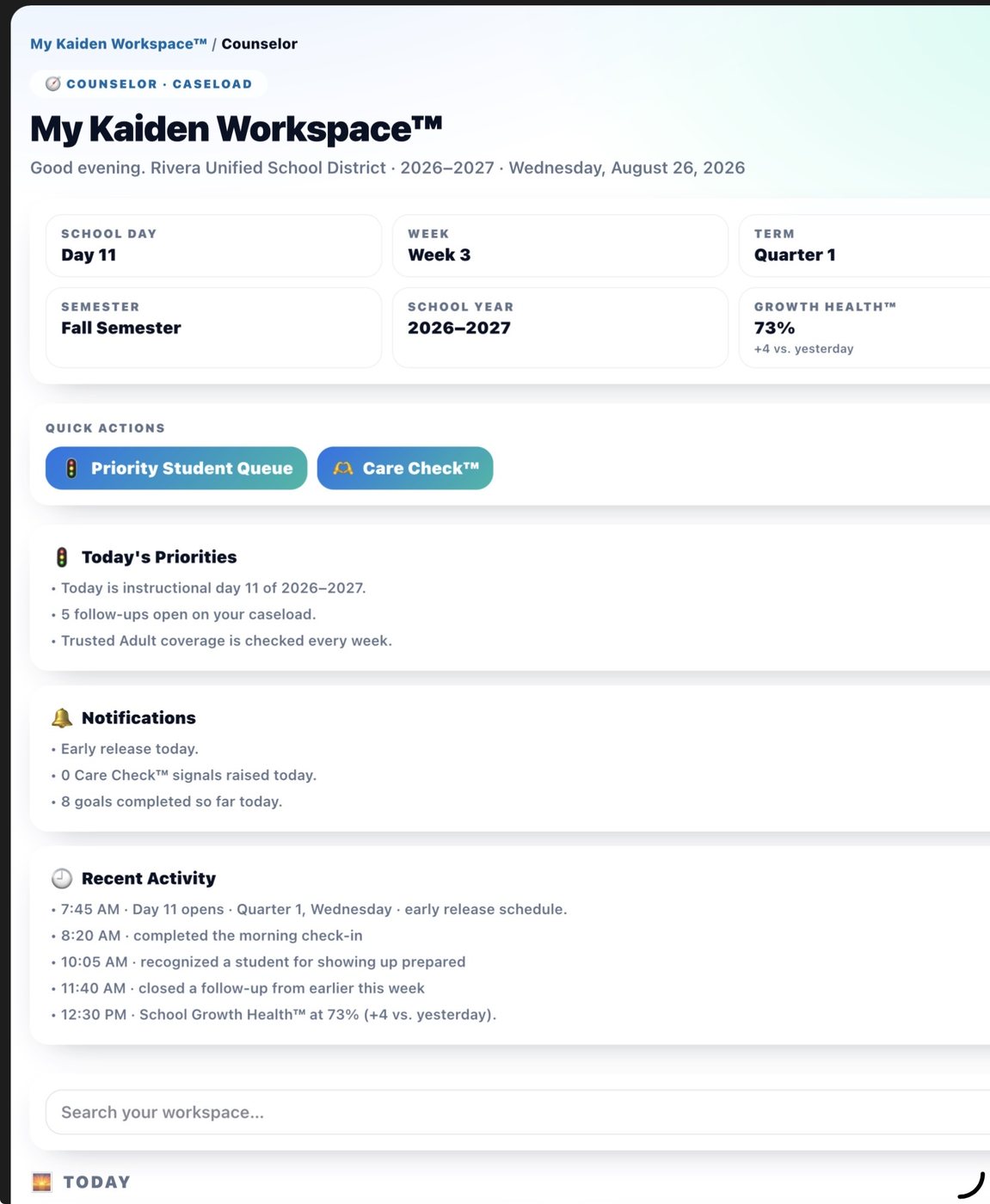
The Counselor workspace surfaces student support requests, open Care Check™ signals, scheduled follow-ups, and caseload activity in one governed workflow. Private counselor notes and confidential documentation remain at school and are not visible to families through the platform.
Role-appropriate visibility. Role-appropriate support.
Student
Owns their daily journey. Initiates support requests. Builds evidence of their own growth.
Teacher
Sees classroom-level signals and student context. Routes support when appropriate.
Counselor
Receives Care Check™ queue. Manages follow-through. Documents outcomes on the authorized timeline.
Family
Receives age-appropriate growth context, recognitions and weekly summaries. Does not see confidential notes.
Principal
Sees school-level participation, support demand and Growth Health™ patterns.
District
Cross-school patterns and executive reporting through the authorized Executive Intelligence™ workspace.
SUPPORT BEFORE FAILURE™
A student should not have to fail a class, receive a discipline referral, stop attending, or reach a crisis before adults recognize something has changed.